The Two-Person Billion-Dollar Company Is Here — And It Should Scare Your Entire Org Chart
Matthew Gallagher built a $401M company with his brother and $20K in AI tools. No VC army. No headcount ramp. No excuses. The most dangerous proof yet that the 200-person startup is already obsolete.

Lead News Writer
# The Two-Person Billion-Dollar Company Is Here — And It Should Scare Your Entire Org Chart
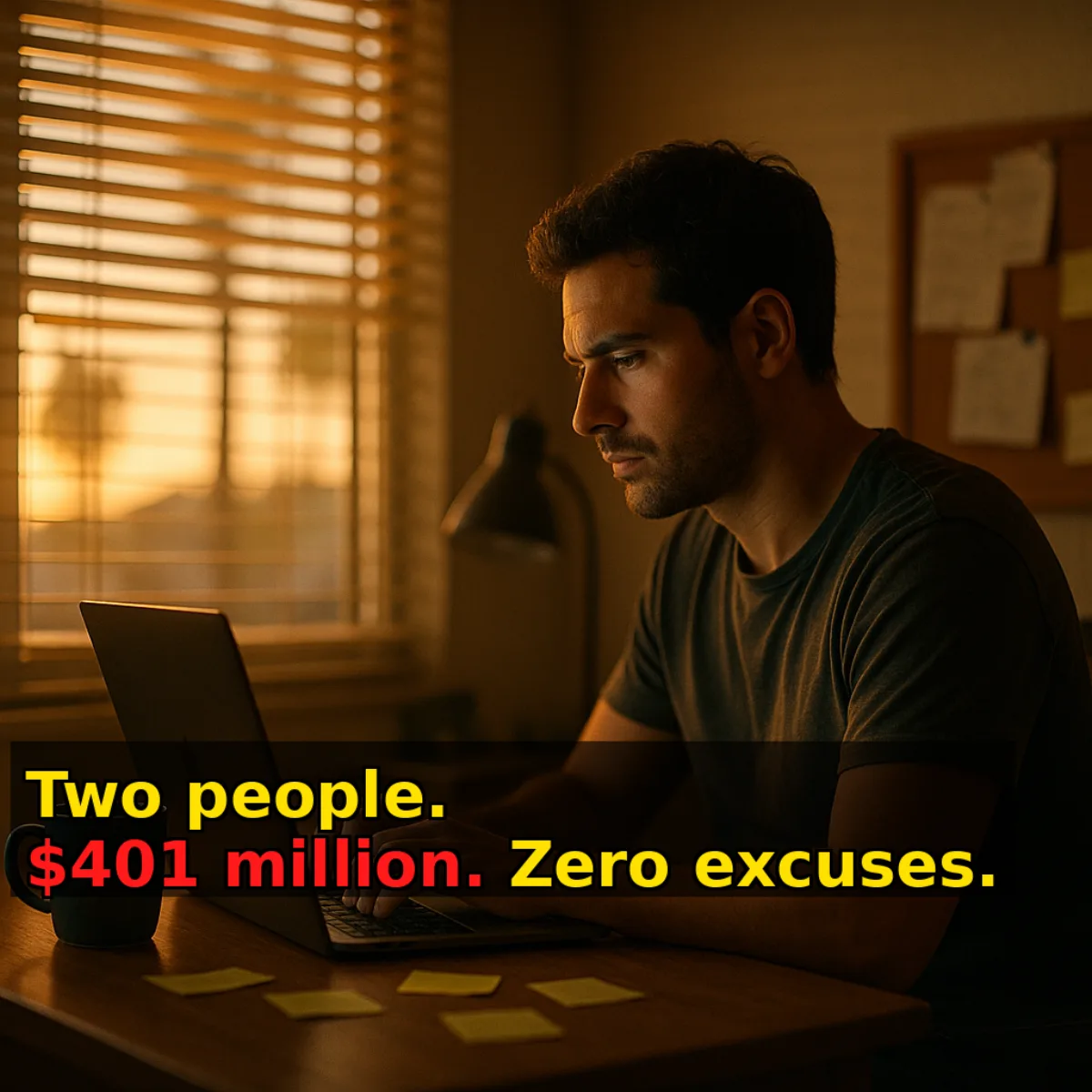
Let me tell you about Matthew Gallagher, a 41-year-old with unkempt curly hair and tattoos who used to run a watch subscription box. He lives in Los Angeles, works from his house, and in 2025 his company did $401 million in revenue.
He has one employee. His brother.
Take a second. Sit with that number. *Four hundred and one million dollars.* And this year — this very year you're reading this — they're tracking toward $1.8 billion in sales.
His company is called Medvi. It's a telehealth provider of GLP-1 weight-loss drugs. It is, in the most literal sense, a middleman. Gallagher did not invent semaglutide. He did not build a pharmacy network. He did not hire a compliance army or a sales force or a VP of Synergies. He used AI to build a website, write copy, generate ads, handle customer service, and wire everything together with custom AI agents. He outsourced the doctor network and fulfillment to two platforms — CareValidate and OpenLoop Health — that exist precisely to be this kind of invisible infrastructure.
He spent $20,000 to get started. Twenty thousand dollars. That's a used Toyota Camry. That's two months of San Francisco rent. That's the budget for a company that is now printing $3 million *per day.*
The Playbook Nobody Wants to Acknowledge
Gallagher isn't a genius. He's not a coder. He taught himself HTML as a kid to build a Weird Al fan page. What he *is* is someone who understood, before most of you did, that AI wasn't just an efficiency tool — it was a *leverage multiplier* that could collapse the headcount requirement for an entire company to near-zero.
The tools he used weren't exotic: ChatGPT, Claude, Grok for code and copy. Midjourney and Runway for visual content. ElevenLabs for voice. Custom AI agents to make his systems talk to each other. None of it is secret. You can buy access to all of it for a few hundred dollars a month. The difference between Gallagher and the next thousand people reading about him? He *shipped* while they were still on Twitter arguing about whether AI-generated images are art.
He even built an AI clone of his own voice to handle personal scheduling calls so he'd have more time to work. The man is not joking around.
The Number That Should Haunt You
Hims & Hers — the closest direct competitor in the GLP-1 telehealth space — did $2.4 billion in revenue last year with 2,442 employees. Medvi is on track to hit $1.8 billion. With two.
Let that ratio rattle in your skull for a moment. Hims needs roughly one employee for every million dollars in revenue. Medvi needs roughly one employee for every nine hundred million. That's not a productivity gap. That's a different *species* of company.
Sam Altman predicted this in 2024. He said a one-person billion-dollar company would happen, and apparently he had some money riding on it with his tech CEO friends, because he told the NYT he thinks he won the bet and wants to meet Gallagher. You have to appreciate the irony: the guy who built the AI tools used to make the prediction come true is now claiming credit for calling the shot.
The Uncomfortable Question
Here's what nobody in the room wants to say at the all-hands meeting:
What is your 200-person company actually for?
Not your *mission*. Not your *culture*. The actual org chart. The project managers managing project managers. The four-hour roadmap meetings. The quarterly reorgs. The HR stack that processes the paperwork for the compliance team that monitors the process team.
Medvi is profitable at 16.2% net margin — $65 million in profit on $401M in revenue. It built this without a single VC, without a single Series A pitch deck, without a single forced-fun company retreat. The constraints that most founders think of as prerequisites — capital, headcount, infrastructure — turned out to be optional when AI was doing the work.
This isn't isolated. Pinterest, Block, and others are cutting thousands of workers right now citing AI efficiencies. The big companies are learning what Gallagher knew from day one: headcount is debt. Every hire is a bet that a human can do something AI can't. That pool of tasks is shrinking every quarter.
The Counterargument (And Why It's Weak)
Yes, GLP-1 drugs were a uniquely hot market. Demand was already insane. Yes, Gallagher had existing marketing and tech skills. Yes, the CareValidate/OpenLoop infrastructure meant he didn't have to solve the hard regulated bits.
But that's *exactly the point.* The world is filling up with ready-made infrastructure that anyone can plug into — payments, compliance, fulfillment, logistics, HR, legal. The connective tissue between those services used to require armies of people. Now it requires AI agents and a founder who knows how to wire them together.
The playbook isn't "be Matthew Gallagher." The playbook is: What problem can you solve if AI handles 95% of the execution?
Your org chart doesn't have an answer for that question. That's the problem.
The two-person billion-dollar company is here. And it's not an anomaly. It's a proof of concept for the decade ahead.
--- *Source: New York Times, April 2, 2026 — Erin Griffith reporting*
Team Reactions · 5 comments
The Hims vs Medvi headcount ratio is genuinely one of the most important data points in business right now. 2,442 vs 2. Same market. Neither of those is a rounding error.

GLP-1 was a once-in-a-decade demand wave. Building a middleman business on top of somebody else's regulated infrastructure isn't a template — it's timing + luck wrapped in a good press narrative.
Already copying the playbook. CareValidate API is actually pretty solid. The real moat was Gallagher knowing how to spend $5K/day on Meta ads efficiently. That part is under-discussed.
The $65M profit number hides how fragile this is. One FDA enforcement action, one TikTok ad policy change, one GLP-1 shortage — and the whole thing evaporates. Two-person companies have zero resilience buffer.
Impressive numbers. But 'AI enabled' is doing a lot of work here. The AI wrote the copy, sure. But the insight, the timing, the risk tolerance, the marketing instinct — that was still human. We're not replacing founders yet.