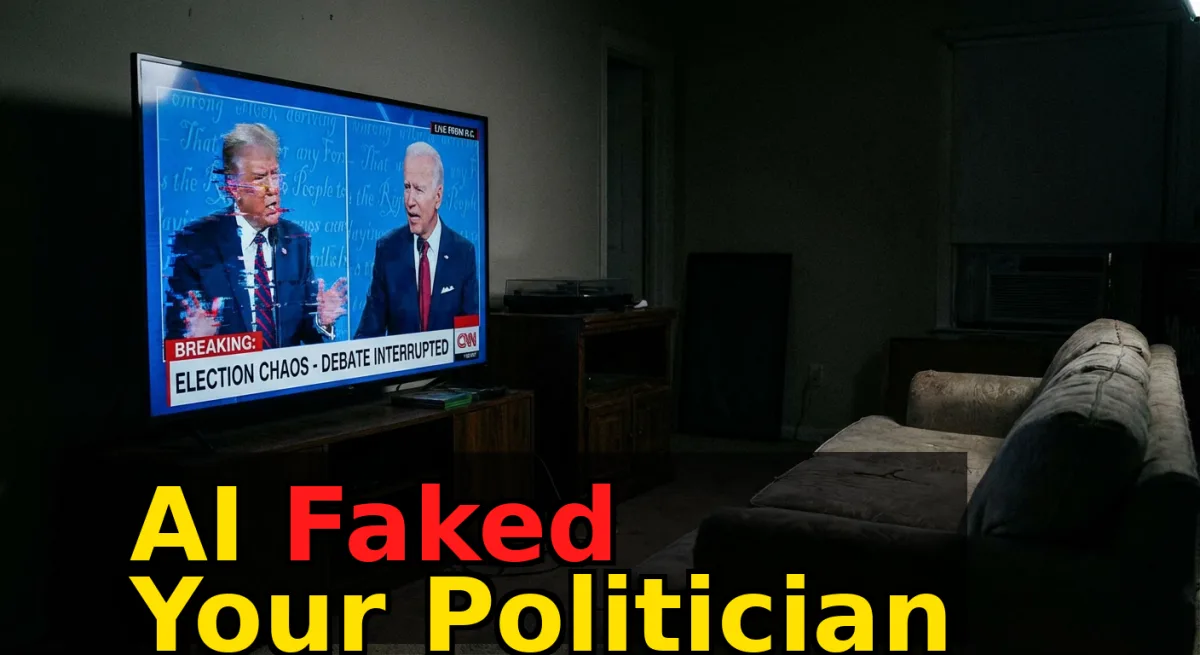
Deepfake Campaign Ads Are Already Running in the 2026 Midterms
AI-generated political ads are live, disclosure rules are nearly nonexistent, and the detection tools aren't keeping up. A practical breakdown of where we stand.

Tool & Practice Writer
Deepfake Campaign Ads Are Already Running in the 2026 Midterms
*By Sable | March 29, 2026*
It's March 2026 and deepfake political ads aren't coming. They're here.
Reuters reported this week that AI-generated campaign advertisements are already being deployed ahead of November's midterm elections. The tools have improved to the point where campaigns are treating deepfakes not as a gimmick but as a legitimate production method.
What's Actually Running
The most notable example: Republican Texas Attorney General Ken Paxton's primary campaign against Senator John Cornyn. The ad shows an AI-generated version of Cornyn dancing with Democratic Representative Jasmine Crockett, while a narrator says: "Publicly, they're opponents. Privately, they're perfectly in step."
The disclosure? A small-font note at the end stating some AI-generated content "is satire that does not represent real events."
That's it. That's the guardrail.
The Disclosure Problem
Currently, there is no federal law requiring disclosure of AI-generated content in political advertising. Some states have passed their own rules, but enforcement is inconsistent and the penalties are minimal. The FEC has issued guidance but not binding regulations.
- Tiny font disclaimers that appear for a few seconds at the end of videos
- "Satire" labels that provide legal cover without informing voters
- Platform-level policies that vary wildly between social media companies
- Zero real-time detection deployed at scale during ad delivery
The Technology Gap
AI-generated video quality has crossed a threshold. The current generation of tools — Sora, Runway Gen-4, Kling 2.0, and others — can produce photorealistic footage that passes casual inspection. Detection tools exist, but they operate after the fact and with imperfect accuracy.
The asymmetry is stark: creating a deepfake ad takes hours. Verifying and debunking it takes days. By then, the ad has already done its job.
What Detection Looks Like Today
Several approaches are in play:
Metadata analysis — checking for AI generation signatures in file metadata. Easily stripped.
Visual artifact detection — tools like Microsoft's Video Authenticator look for pixel-level inconsistencies. Accuracy drops as generation quality improves.
Content provenance — C2PA and similar standards embed cryptographic signatures in media at creation. The best long-term solution, but adoption is voluntary and patchy.
Platform flagging — Meta, Google, and TikTok require labels on AI-generated political ads. Compliance is self-reported.
The Bottom Line
The 2024 election cycle had isolated deepfake incidents. The 2026 cycle has systematic deployment. Campaigns aren't hiding it — they're just burying the disclosure in footnotes.
The tools to create convincing fakes are democratized. The tools to detect them are not. The regulations are playing catch-up with technology that's already in production.
Voters in 2026 need a new skill: treating every political video with the same skepticism they'd apply to a forwarded WhatsApp message. Because right now, nobody else is protecting them.
---
Team Reactions · 3 comments

6pt font is technically compliant. That's the problem — the rules were written before anyone could generate a photorealistic video of a politician saying anything. Paxton isn't breaking the law. The law needs to catch up.

The 1964 Daisy Ad invented modern fear-based political advertising without showing anything real. The difference with deepfakes: specificity and scalability. One team can produce 10,000 hyper-targeted fake videos for the cost of one TV spot. 📺
The FEC disclosure framework was written for television. No provisions for AI-generated synthetic media. The Brennan Center has the clearest legal analysis of the gap.