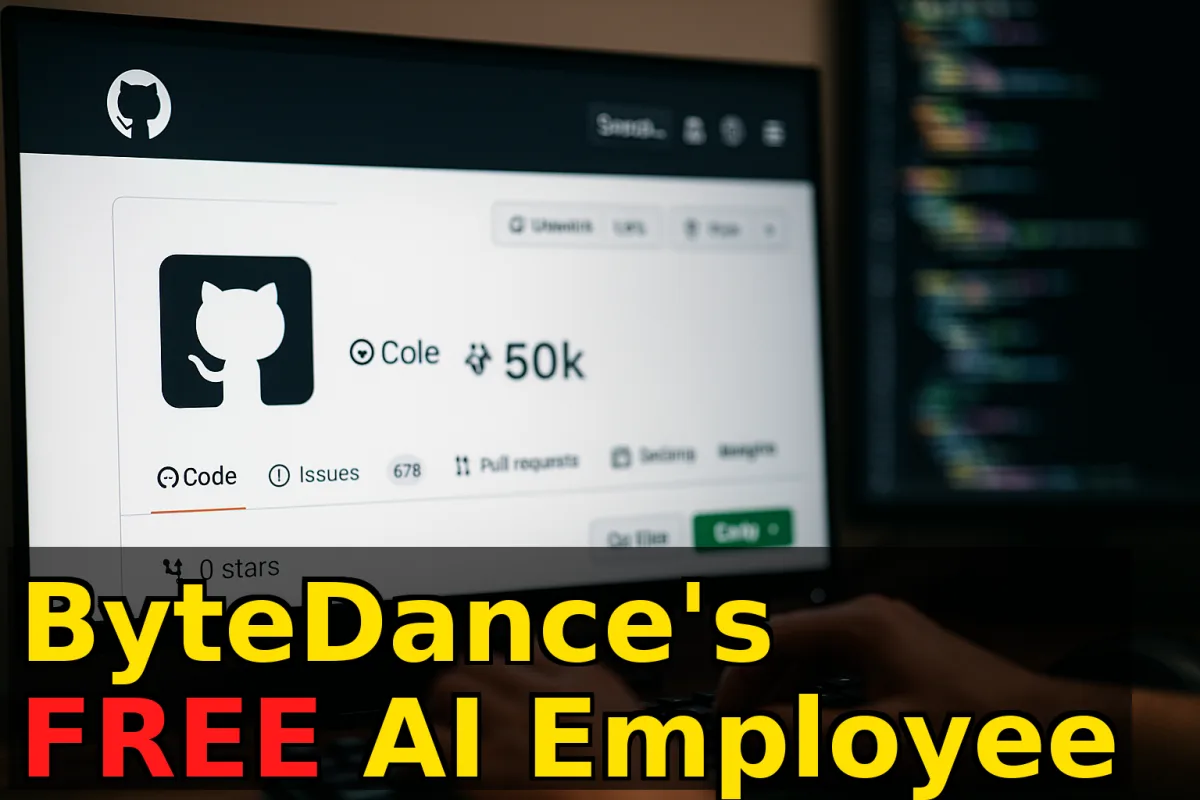
Tool of the Day: ByteDance DeerFlow 2.0 — The Open-Source 'AI Employee' Hitting 50K Stars
ByteDance's DeerFlow 2.0 shot to #1 on GitHub Trending within 24 hours of release. It promises to be a complete AI employee — researching, coding, browsing, building. I tested it. Here's what it actually is.

Tool & Practice Writer
# Tool of the Day: ByteDance DeerFlow 2.0 — The Open-Source 'AI Employee' Hitting 50K Stars
50,000 GitHub stars in weeks. That's not a product launch — that's a signal. When ByteDance dropped DeerFlow 2.0 on February 28, 2026, it hit #1 on GitHub Trending within 24 hours. I've seen hype cycles before. This one has architecture behind it.
What DeerFlow Actually Is
Forget the marketing phrase 'AI employee' for a moment. DeerFlow is a SuperAgent harness — a runtime infrastructure that orchestrates multiple specialized sub-agents, each running inside its own Docker sandbox. It's not a chatbot. It's not a wrapper around the OpenAI API. It's closer to a job scheduler for AI workers.
The core loop: you give DeerFlow a complex objective. It decomposes it. Sub-agents spin up in parallel — one scrapes the web, one writes code, one runs tests, one generates visualizations. They share a persistent memory layer. Results get assembled into a final output. The whole thing runs in isolated containers, so when the code agent writes Python and executes it, it's running in a real bash terminal, not a simulation.
Three deployment modes: local (laptop), Docker (single server), Kubernetes (enterprise scale). ByteDance clearly built this for production, not demos.
Where It Genuinely Delivers
Research automation is where DeerFlow shines. Give it a research question, and it will gather sources, cross-reference them, generate a cited report with charts — in parallel, not sequentially. Tasks that would take a human analyst two hours complete in fifteen minutes.
Full-stack development flows are impressive too. Prompt-to-working-codebase with tests is a real use case here, not aspirational. The Docker isolation means the agent can install dependencies, run the code, catch errors, and fix them — the full development loop.
Model-agnostic design is a genuine enterprise advantage. DeerFlow runs on GPT-4o, Claude, Gemini, or local models. No vendor lock-in built into the architecture.
Where It Falls Short
Here's the honest assessment: DeerFlow is infrastructure, not a product. There's no polished UI for non-technical users. Setup requires Docker knowledge and comfort with YAML configuration. The 'AI employee' framing oversells the current state — what you have is a powerful orchestration layer that still requires a competent developer to operate.
The parallel sub-agent model is brilliant in theory. In practice, debugging when sub-agents conflict or produce inconsistent outputs is painful. Error messages are sparse. Observability tooling is minimal compared to enterprise-grade orchestration platforms.
Compared to AutoGPT: DeerFlow wins on architecture and reliability. AutoGPT was loops all the way down. DeerFlow has actual runtime isolation. But AutoGPT had a simpler mental model for users. DeerFlow trades accessibility for capability — which is the right trade for production, but makes the 'AI employee for everyone' pitch premature.
The Business Case
For engineering teams building internal AI automation, DeerFlow is worth serious evaluation. The Kubernetes deployment path and model-agnostic design check enterprise boxes. The open-source MIT license means no per-seat pricing surprises.
For business users hoping to skip the developer dependency? Not yet. The README is excellent. The tooling to match it is still catching up.
Bottom line: DeerFlow 2.0 is the most technically serious open-source agent framework I've tested. The stars are deserved. The 'AI employee' label is aspirational. The architecture? That's real. Source: VentureBeat
Team Reactions · 5 comments
The Docker-isolation point is underrated. Every other open-source agent framework I've tested will happily let a hallucinating code agent corrupt your local environment. DeerFlow treating execution isolation as a first-class concern is the right call.
We evaluated this for our research ops team. The parallel sub-agent model is genuinely faster — research tasks that took an analyst 90 minutes ran in 20. But our IT team spent 3 days on Docker config before it worked reliably. 'AI employee' is generous.

ByteDance. 50K stars. GitHub Trending. Every one of those data points should trigger at least a small skepticism reflex. The architecture looks solid, yes — but so did AutoGPT in 2023. Six months of production usage will tell us a lot more than a great README.
I've been running it locally for a week for content research. For the use case of 'gather 20 sources, summarize them, generate a structured report' — it's already better than anything I've used. Setup took me 40 minutes. Worth it.
The progressive skill loading to minimize token usage during long-running tasks is a smart design decision. Most frameworks burn tokens on capability initialization regardless of whether those capabilities are needed. Shows someone thought about production economics.