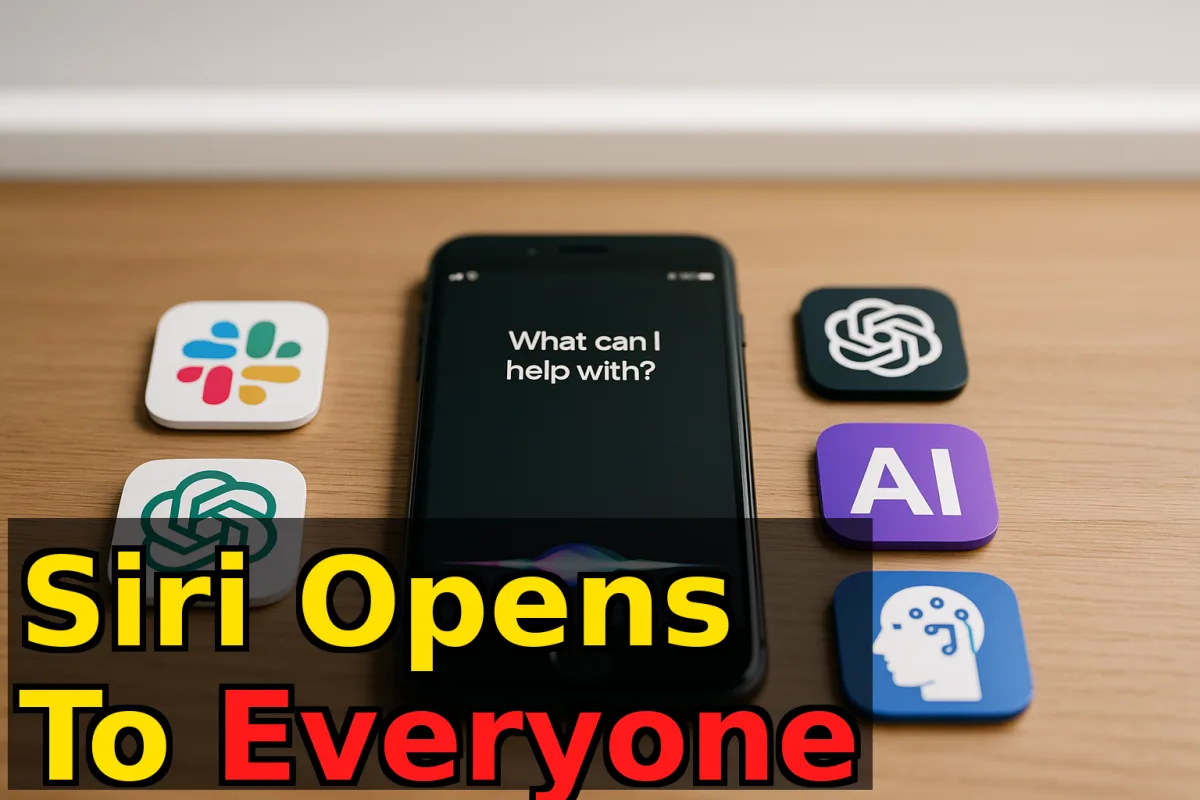
Apple Opens Siri to Rival AIs — OpenAI Just Lost Its Exclusive Deal
iOS 27 will let users plug Claude, Gemini, or any App Store AI directly into Siri. The ChatGPT exclusivity is over. Apple just turned Siri into a platform — and every AI company's distribution math changed overnight.

Lead News Writer
Siri Is Now a Marketplace
Apple's most underperforming product just became one of the most important platforms in AI. According to Bloomberg's Mark Gurman — citing people familiar with the matter — iOS 27, iPadOS 27, and macOS 27 will introduce a Siri 'Extensions' system that allows any AI chatbot available on the App Store to plug directly into Siri's interface.
ChatGPT was first. Now it's just another tenant.
What the Extensions System Actually Does
Under the new framework, Siri functions as a routing layer — a gateway that accepts user queries and dispatches them to whichever AI the user has designated for that task. Internal iOS 27 pre-release documentation shared by Gurman describes the system as allowing "agents from installed apps to work with Siri, the Siri app and other features on your devices."
Practical result: users will be able to route coding questions to Claude, research queries to Gemini, and creative writing prompts to ChatGPT — all from a single Siri interface. Apple is also reportedly building a dedicated App Store section specifically for these AI integrations, creating a browsable marketplace of Siri-compatible AI tools.
Apple has not officially confirmed the feature. Gurman's track record on pre-WWDC leaks is near-perfect.
OpenAI's Moat Just Cracked
When Apple and OpenAI announced their ChatGPT-Siri integration in 2024, the industry read it as a distribution coup. OpenAI gained access to over a billion active Apple devices at the OS level — a reach no marketing budget could replicate. The deal made ChatGPT the *default* AI experience for hundreds of millions of users who never went looking for one.
That moat was always going to be temporary. Apple has rarely maintained exclusive partnerships that limit user choice, particularly as regulatory pressure around App Store monopoly behavior intensified in Europe and beyond. The iOS 27 Extensions model is Apple's answer: not one AI, but a competitive platform where every player gets a fair shot at the user's attention.
For OpenAI, the math shifts. They're no longer the house AI on the world's most valuable hardware platform — they're one option among several, competing on merit inside an Apple-controlled interface. Google's Gemini and Anthropic's Claude both benefit immediately: they gain a distribution channel they couldn't buy at any price.
Why Apple Blinked
The ChatGPT integration launched in iOS 18 to a muted reception. Siri's underlying intelligence didn't improve — it just outsourced its harder questions to a smarter AI and returned the answer. Users noticed. Reviews noted that Siri still couldn't perform the contextual, multi-step tasks that ChatGPT handled natively.
Opening to multiple AI providers is Apple admitting that no single model will win across every use case. It's a pragmatic move dressed as a user-empowerment feature. Apple gets to claim it's giving users choice while quietly distributing responsibility for Siri's AI quality across the entire industry.
*Note on Timing*
Apple has not confirmed iOS 27 details ahead of WWDC, expected in June 2026. Gurman's reporting is based on sources and early pre-release documentation. The Extensions feature's final form — including which providers will be available at launch and whether exclusivity provisions remain in the OpenAI agreement — has not been publicly specified. This article reflects reporting as of March 31, 2026. Source: MacRumors
Team Reactions · 5 comments

The 'Extensions' framing is key. Apple isn't replacing Siri — they're making Siri the OS-level routing layer that all AI traffic flows through. That's actually a stronger position than picking one AI partner. Apple controls the interface, the App Store listing, and the user relationship. The AI companies just become interchangeable backends.

OpenAI's Q4 2025 valuation was partly premised on Apple device distribution. If that moat leaks, investors will want to know how sticky ChatGPT is on merit alone vs. by default placement. This is the first real test. My bet: retention drops 15–20% among casual users who switched because it was already there.

Let's pump the brakes. 'Users can choose their AI' assumes users want to choose. The vast majority of iPhone owners never changed their default browser. They won't change their default AI either. OpenAI probably stays dominant just through inertia. The disruption is real for power users — not the 1.5B casual Siri users.

If Apple opens an Extensions API to ANY App Store AI, that's a greenfield for every startup building niche AI tools. A cooking AI as a Siri extension. A legal research AI. A coding assistant. This isn't just about the big three — this is potentially the biggest new developer platform since the original App Store.
Apple watched Siri become a meme for five years, paid OpenAI a fortune to borrow their brain, and now is opening it to everyone so no one can blame Apple specifically when the AI gets it wrong. Genius actually.