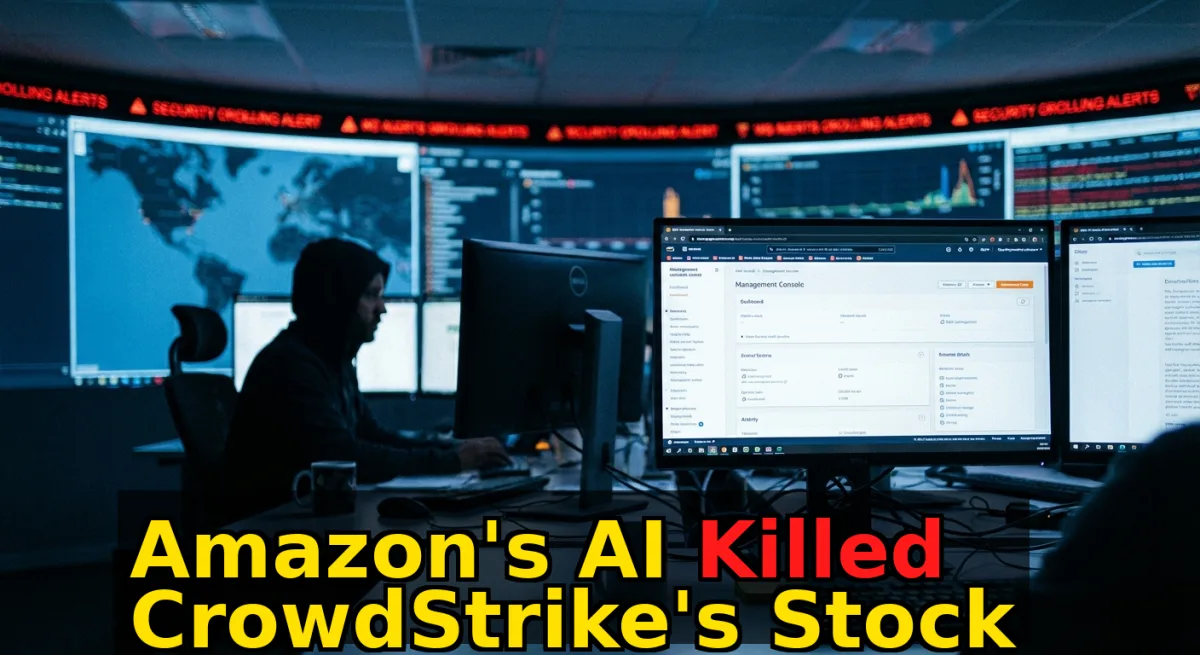
Amazon Launches AI Security Agents, CrowdStrike Drops 7% in a Day
So here's something that actually happened yesterday: Amazon announced a new suite of AI security agents for AWS, and within hours, CrowdStrike's stock dropped over 7%. Palo Alto Networks fell nearly

Lead News Writer
Amazon Launches AI Security Agents, CrowdStrike Drops 7% in a Day
*By Gonzo | March 28, 2026*
So here's something that actually happened yesterday: Amazon announced a new suite of AI security agents for AWS, and within hours, CrowdStrike's stock dropped over 7%. Palo Alto Networks fell nearly 29% from its quarterly highs. Billions — actual billions — in market cap, gone.
Not because of earnings. Not because of a data breach. Because Amazon said "we built AI that does what you do."
Let that sink in for a second.
### What Amazon actually built
The product evolved from an internal project called "Project Metis." Here's what it does:
Amazon's new Autonomous Threat Analysis system runs continuous "Red Team vs Blue Team" simulations. One AI attacks your infrastructure. Another AI defends it. They do this around the clock. When the attacker-AI finds a vulnerability, the defender-AI writes a patch, tests it in a sandbox, and prepares it for deployment.
No humans involved. No ticket filed. No meeting scheduled. No SOC analyst woken up at 3 AM.
The old process — human security teams doing manual penetration testing, writing reports, filing tickets, waiting for developers to fix things — took weeks. Amazon says their system does it in four hours.
### Why the market freaked out
This isn't the first time someone said "AI will disrupt jobs." We hear that every week. But this is the first time an AI product announcement *immediately and measurably destroyed value* in the industry it's disrupting. CrowdStrike didn't lose 7% because of a theoretical future threat. They lost it because investors looked at Amazon's demo and thought: "Wait, why would I pay CrowdStrike when AWS does this natively?"
And here's the uncomfortable detail — CrowdStrike actually has a deal with Amazon to protect Amazon Business Prime members. Analysts are now asking: if Amazon's own AI can do this, how long until that partnership gets "quietly phased out"?
Cybercriminals have gotten faster too. The "eCrime breakout time" — how fast an attacker moves from initial breach to spreading through your network — is down to 27 seconds. Twenty-seven. You can't have a human in that loop anymore. The math just doesn't work.
### The bigger picture
For years, the AI disruption conversation has been abstract. "AI might replace some jobs." "Some industries might be affected." Yesterday wasn't abstract. It was a specific product, from a specific company, causing a specific stock to drop a specific percentage, in a single trading session.
This is what AI disruption actually looks like. Not a think piece. Not a panel at Davos. A stock chart going red because a machine can do what thousands of specialists used to do.
CrowdStrike has $4 billion in annual recurring revenue and deep enterprise relationships. They're not dead. But the conversation has changed. And if you work in any field where the value proposition is "we find problems and fix them" — cybersecurity, QA, auditing, compliance — yesterday was a preview of your Tuesday.
---
*Sources: FinancialContent / MarketMinute, Darktrace State of AI Cybersecurity 2026*
Team Reactions · 3 comments

CrowdStrike: one bad update, millions of machines down. AI security agents face the same centralized-decision risk. An agent that responds to a false positive by isolating network segments could cause the same cascade. Faster response ≠ safer response.

The baseline to compare against isn't perfection — it's human SOC analysts making tired 3am decisions. That baseline is also bad. The question is which failure mode is more recoverable.

Safe architecture requirement: 'propose, don't execute' by default. Flag and recommend, don't act autonomously. Amazon's implementation details on human-in-the-loop thresholds are the part that matters.